Tuesday, June 19, 2018

Homily for the First Solemn Mass of Thanksgiving of Fr. Anthony M. Infanti


Fr. Anthony M. Infanti.

Ordained a Priest June 16, 2018
First Solemn Mass of Thanksgiving, St. Agnes Church, Blackwood, NJ, June 17, 2018  

It is said that you don’t really get to know a person until you live with him.  I know that is true with Fr. Anthony and me.  Although, at that time, I was pastor of St. Joseph Parish, Somers Point, and he was a—how should I put this?—a wanna be (once again) seminarian.  In other words, Anthony really wanted to return to the seminary to be a priest.

In case you don’t know our precise history:  Bishop Sullivan asked me to take Anthony for the fall of 2014—until Christmas.  This subsequently turned into “Can he remain with you until the Spring?” which then morphed into “Can you keep him there for the summer months until he re-enters the seminary?”  Like the guest who comes for a short visit and then doesn’t know when to leave, I had Anthony for the year.  What was it that Ben Franklin said?  Guests, like fish, begin to smell after three days.  Although, I must say, Fr. Anthony, I never noted any glaring problems with your personal hygiene.

Once he re-entered the seminary, Anthony would return to the parish on various occasions.  I affectionately referred to him as our feral seminarian.  You know—like a feral cat who shows up at the back door of the house wanting to be fed.  Admittedly, out of compassion, I, in a moment of reoccurring weakness, fed him and took him in.

I was charged with evaluating Anthony and his suitability to return to the seminary to become a priest.  And this I did.  What I found was the following when I asked myself some questions:

·       Was he a man of PRAYER?  In the rectory we had a small oratory/chapel.  I would often see him praying there.  He asked me if I would like to pray Evening Prayer with him.  I noted his love for the Blessed Sacrament.  I checked off yes in answer to this question.

·       Did he have REVERENCE for the sacred?  I looked at his disposition at Mass. I saw reverence toward sacred things in his actions.  He exuded a reverence and respect at the altar as a seminarian, deacon and now as a priest.  Another check mark in the yes column.

·       How was his INTELLECT?  I think it would be fair to say that Anthony struggled a bit with his studies.  Things did not always come easily for him.  But he was willing to learn.  He would ask me questions and advice.  And I realized that Jesus chose fishermen and a tax collector who were not always the best or the brightest.  My intuition was that Anthony would be okay, with the proper guidance.
 
·       Did he have a big EGO?  It didn’t seem that Anthony took himself too seriously.  Nor did he suffer from a cult of personality wanting only to be liked all the time.  We need only to look at Jesus on the cross to see that He was not liked by all and that there would be some people in opposition to His message.  I didn’t see Anthony’s ego getting in the way of him being a good priest, but rather a sense of humility.  Another check in the yes column.

·       Would he be a good SHEPHERD?  I noted how Anthony was attentive to his Communion Calls and took care of the needs of the sick and homebound.  He would remind me when one of them wanted to go to confession or needed to be anointed.  He went over to the parish school to teach the children.  He was received well by the parishioners, in general.  We are reminded in Sacred Scripture:  A Good Shepherd lays down his life for the sheep (John 10:11).  I thought of the example of St. Maximilian Kolbe to whom we both have a devotion.  He gave his life as a priest for a family man in the concentration camp at Auschwitz. Another check.

·       Did he have a sense of THANKFULNESS?  One only needs to have received one of Anthony’s “thank you” notes to realize that he had a profound sense of gratitude for what is done for him.  Check.

Take all the above qualities, Prayer, Reverence, Intellect, (a diminished) Ego, Shepherd and Thankfulness, put them into the blender and there seems to be many of the necessary ingredients needed to be a P-R-I-E-S-T.

My evaluation was one evaluation among many others to come—from the seminary, from his parish assignments, from the vocations office and the Bishop himself.
 
It all culminated in the formal “call” to priesthood and ordination by Bishop Sullivan yesterday.

As I was riding in my car one day listening to music on the radio, I heard a song that made me think immediately about your journey to the priesthood.  Although you will probably kill me for mentioning the artist—Miley Cyrus—at your First Mass, Fr. Anthony this is your song.  It describes your journey, your climb.  Here are some of the words:

The Climb

I can almost see it
That dream I'm dreaming but
There's a voice inside my head saying
You'll never reach it . . .

My faith is shaking but I
Gotta keep trying
Gotta keep my head held high . . .

Ain't about how fast I get there
Ain't about what's waiting on the other side
It's the climb

The struggles I'm facing
The chances I'm taking
Sometimes might knock me down but
No I'm not breaking
I may not know it
But these are the moments that
I'm going to remember most . . .


Now it’s time to get to work—Jesus’ work continues.

Yesterday was a priesthood ordination, not a canonization.  Fr. Anthony, your work as a priest is just beginning.  May I remind you and all of us of the concluding words from today’s second reading:

For we must all appear before the judgment seat of Christ, so that each may receive recompense according to what he did in the body, whether good or evil. (2 Cor. 5:10)

Priesthood is not about you or me or any of the priests here today.  It is about Jesus Christ, the Great High Priest.

Like St. John the Baptist, He (Jesus) must increase, and I (we) must decrease.  (See John 3:30)

Learn a couple valuable lessons from today’s gospel.  The planting of seeds will be like your preaching and words—Christ’s words—that will go out to the people. May they take root in them.  Then there is the parable of the mustard seed.  It is the story of the Church that started with twelve apostles and grew into over two billion Christians—1.2 billion of them Catholics.  It is the story of St. Teresa of Calcutta who began by ministering to the first dying person in the streets of Calcutta with no plan, no budget.  This ministry grew into the Missionaries of Charity all over the world.  It is the story of St. Francis of Assisi who divested himself of his family’s business after hearing the call from the Lord to Rebuild My Church.  People today as then probably thought he was crazy. Today there are so many different types of Franciscans throughout the world following his spirituality.  It is the story of two newly ordained priests for the Diocese of Camden who, with the Grace of God, will do great things for the People of God.
  
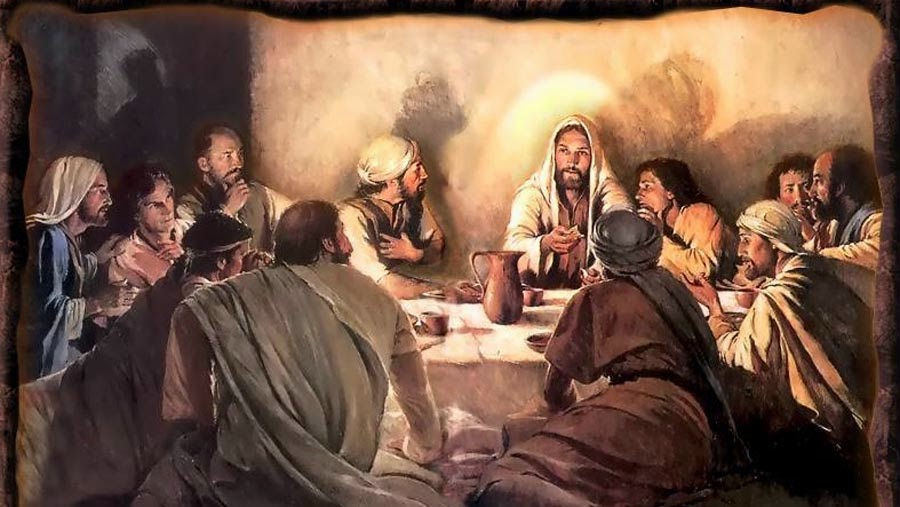
Please remember the example that Jesus gave His disciples in the mandatum or washing of feet at the Last Supper.  According to a commentary that I once read in preparation for a homily, no Jewish slave could be compelled to wash someone’s feet:

At the Last Supper, Jesus would have been the “host” and the apostles the “guests.” Washing the feet of weary travelers would have been a job delegated to a gentile slave by the host.  Not even a Jewish slave would be expected to wash feet. The host of a meal would certainly not lower himself to performing this vile task himself.

Yet we see in the Gospel how Jesus humbles himself to wash the feet of His disciples.  The God of Heaven and Earth who is responsible for us--His creatures—being here in the first place, not only became one of us (a human being) in Jesus, but He stooped to do something that not even a Jewish slave would do.  This washing of feet is an example of how Jesus poured Himself out for us—how He extended Himself for the sake of others.  It was a profound act of humility.  No wonder Peter would object to such an action!

Today is Father’s Day and I know it is bittersweet because of the recent passing of your father Michael. Our hope, as Christians, is that he be in heaven with God looking down on us and spiritually present with us now.  Now, you as a priest, you carry the title Father as a spiritual father to your people.

While your own mother, Patti is here to support you, do not forget to pray continually for the intercession of the Blessed Virgin Mary. She is your spiritual mother. She is the mother of the Great High Priest, Jesus Christ, and is mother of all priests.

As a former high school principal, I would frequently express the following sentiment to my graduating seniors:  Go out and Make me proud.   I say the same to you Fr. Anthony:  Make me proud.  Make your mother and father and family proud.  Make your Bishop proud.  Make your parishioners proud.  Make us all proud.  No pressure!

Ad multos annos.

Wednesday, November 9, 2016

2016 Post-Election Commentary (from a Priest’s Perspective)


As I stopped in Wal-Mart today to pick up a few items, the employees were discussing the 2016 Presidential election.  Later, when I drove my car into the church parking lot, some others were doing the same.  Facebook is loaded with all sorts of reactions—from rejoicing, to tears, to uncertainty, to fear, to whatever.  This unprecedented election is certainly being discussed by just about everyone I know.  This evening’s news also showed protests in the streets in some cities.

Although there are those who have already criticized me and told me that I need to be silent as a priest for having an opinion on political matters, political parties and elections, I suspect that they do not grasp the role and charge of the Church and of a priest to preach the Gospel in season and out of season. (See 2 Tm. 4: 1-5) This may include pointing out wrongdoing and injustice within any and all government structures.   Christ might not have been a political activist—being, rather, most critical of the religious leaders of His time.  However, his death on the cross nonetheless was at the hands of an oppressive Roman government.

[As a brief aside, I wonder if critics of vocal priests might have said the same to Pope St. John Paul II as he stood up against communism in Poland, being a force and inspiration for the Solidarity movement.  Or would they criticize Blessed Fr. Jerzy Popieluszko, a priest brutally killed by the Polish secret police for being outspoken against the same communist government at the time of Solidarity.  If my memory serves me right, approximately twelve thousand priests died during the Holocaust—many for being a voice of resistance against the cruel Nazis.  I also think of Sts. Thomas More and John Fisher, and other Martyrs of England and Whales unwilling to submit to the king.  While I can write volumes giving such examples of opposition to unjust governments and their practices, this is not the primary point of my commentary.]

We, as a nation, have been through a rather bitter, definitely unedifying, hard-fought contest for US President.  People have taken sides and, at times, demonized opponents, and shown great contempt and anger towards those who do not share like opinions.  I have heard how people are fearful for the future, motivated to become activists, frustrated or even paralyzed.  Others are praising the new president like a messiah. I try to avoid any of these attitudes.

Here’s where I share my priestly insight:  politics is a thing for this world.  Christian believers are urged to set your hearts on things that are above. (See Col. 3: 1-4)  God is still in charge.  He always has been and will be.  I hope we realized that one of the two major candidates was going to win this election.  I did not endorse either of the two or any other on the ballot.  I was, however, highly critical about what one party/candidate stood for, primarily because I am a strong, openly-declared opponent of abortion.  I think the lives of 60 million unborn children who have been aborted in the US since Roe v. Wade deserve the additional voice that I can give (that they never had) to help stop the madness.  (Maybe my voice and those like me could influence a move in another direction respecting the life of the unborn, just like Sen. Bernie Sanders and his supporters advocated for and seemingly achieved various positions in their party platform more to their liking.)

If we have a deep faith in Jesus, then we can be assured that His will is going to be done.  Maybe not immediately, maybe not in the way I/we will understand.  What I see as tragic are attitudes where politics is more heavily weighted in people’s lives—and I am especially addressing Catholics and Christians here—than their faith.   Faith can motivate one to take a more active role in politics, but politics is never, ever more important than faith in Jesus Christ.  When activist priests stood up against oppressive governments and their policies, it was certainly faith in Jesus Christ, faith in an afterlife, faith in the ultimate power of God, motivating and sustaining them.

We should teach our families, our children and others that no matter what happens, Jesus is still with us.  According to our faith, Jesus is with us in the Most Blessed Sacrament, in the Sacred Scriptures, where two or three gather in His name (the Church), and in the person of the ordained priest.  It doesn’t matter in the end who is president, or king, or emperor.  Nations have come and gone.  Isn’t it strange and assuring that the Church has survived all governments (corrupt, oppressive and otherwise) since 33 AD?

I have no grandiose expectations that President Donald Trump or any other after him will solve all of our nation’s problems.  He can’t because he’s not God.  I will be critical of him if he doesn’t support legislation respecting life in the womb, if he doesn’t protect religious freedom and its expression, if he advocates same-sex marriage, etc.  At least his party did not officially adopt policies in their platform that are blatantly against non-negotiable teachings of the Catholic Church (abortion, same-sex marriage).  I hope his administration doesn’t want the Little Sisters of the Poor to violate their religious beliefs.

Our nation, in the end, will not change in the most beneficial ways for our society, unless we change.  Maybe I will sound a little more like my Protestant brothers and sisters here than the ultra-conservative, Catholic priest, as I have sometimes been erroneously labeled.  (In reality, I am far from that.  I just try to be faithful to what the Church teaches doctrinally.)  My point:  Jesus has to be in my heart and soul.  I have to live and breathe Him.  I have to give my will and my life to Him.  I need a personal relationship with this most-loving Person of the Trinity.  Too many baptized just go through the motions, pick and choose what they want to believe, and never know the peace and joy that comes from being a faithful disciple of the Lord.  Pope Emeritus Benedict XVI called the half-hearted practical atheists.  Their faith never has an effect on the way they live their lives.  Pope St. John Paul II called for a New Evangelization to bring back baptized Catholics/Christians who no longer practice their faith.

To those who are baptized Catholics, I say this boldly:  BE Catholics!  Know and support your Church and its teachings.  Faithfully attend Mass.  If your life is not right with God, take the steps necessary to make it so.  Confession is a good start and a wonderful grace-filled habit to get into.  The Jubilee Year of Mercy, emphasizing the merciful love of God, is nearing its end (Nov. 20, 2016).

Politics is sometimes interesting and occasionally bizarre.  (I never thought I would be saying President-elect Trump.)  However, knowing and living the Catholic faith is life-giving, hope-providing and charity-enabling

No political-pabulum of a slogan (Make America Great Again or Stronger Together) is, in and of itself, going to make anything happen. 

Only God can produce the result He chooses by His WordLet there be light . . . Let us make man . . . . .  Jesus, the Son of God, said: This is My Body.  And it becomes so.

If we want things to happen, real change to occur, then it is only through God’s Word and in cooperation with God’s Will that will make it so. 


O beloved Christian, O Child of God, have faith and trust in Jesus and not some politician.  

Jesus has no term limits as messiah or God.

Sunday, August 28, 2016

A Nation Facing Collapse?


I hope and pray I am completely wrong about what I am about to say.  I fear, however, I am not.

Our nation is in a most tragic place right now.  If it were given a medical prognosis I would have to say the current illness is extremely grave but more probably terminal.  Sure, we have pulled through some horrendous times in our history including world wars, natural disasters, and economic collapses.  America can be proud of so many noble accomplishments of its past and present.  Moreover, its many outstanding citizens have contributed to a society that has, at one time or another, led the world in almost every conceivable area.

So what went wrong?  Let me start with two decisions by our government that will be seen as tragically erroneous resulting in most dire consequences.
 
Roe v. Wade and the legalization of abortion in this nation will one day be seen by all before God for what it truly is—the systematic extermination of innocent human life.  Abortion was never and will never be a moral good.  The big lie that a woman has a right to choose [to kill innocent human life] is completely absurd and delusional.  Babies killed legally are nonetheless killed most tragically.  Whether ripped apart surgically or chemically poisoned, such abortions are never safe for the developing baby and leave the victimized mother scarred for life.  The blood of approximately 60 million innocents cries to God for justice since 1973.

Next, the legalization of gay marriage in our nation shows how we have abandoned and replaced the divine institution of marriage—between one man and one woman—for what we “enlightened” humans see as an alternative to God’s design for the human race.  Under the misguided pretext of tolerance and acceptance, we have attempted to counter-establish same-sex relationships as a type of norm.  The complimentary between male and female with its life-giving potential are thus disregarded.  While God’s love for us and the love we must show as Christians for one another (see John 13:34, 15:12) never permit others to be treated uncharitably, humans can never supplant divine wisdom with human "wisdom" and redefine a divinely established institution.  Our declaring something legal and culturally acceptable does not make it so in the sight of God.  We are foolish to think otherwise.

It is obvious that the breakdown of the traditional family has been progressively occurring.  Observe the divorce / remarriage statistics in conjunction with societal acceptance of abandoned commitments.  Multitudes of babies are born out of wedlock.  The varied possibilities defining the concept of “modern” family are as numerous as the random combinations of a slot machine.   Not insignificant to the situation is that artificial contraception and sterilization procedures attempt to allow man to play god and to divorce procreation from the unitive act.  Moreover, the issue of individually chosen sexual identity taking precedence over God-given genetic sexual identity only complicates the entire scenario.  If the building blocks of society are strong families, then our structure is crumbling most rapidly.

Moral values have become relative, truth is up for individual interpretation and debate, and society seems to think that the only grave sin is intolerance.  I am amazed how so many Catholics Christians have seemingly abandoned the teachings of Jesus Christ and timeless Gospel values as the norm for living, substituting instead ethereal, culturally-driven ethics.  Notably, co-habitation before or in place of marriage is the new standard.  Sex became automatically part of dating and simply a recreational, “feel-good” activity.  Any notion of delayed gratification is considered absurd.  At the same time, the number of people with a sexually transmitted disease (S.T.D.) is staggering.

In place of seeking God, a hedonistic society apparently finds its joy in varied combinations of drugs, alcohol, sex, pornography, gambling, material possessions, travel, wealth, power, prestige, and whatever else may feed the insatiable ego and titillate the senses.  As long as it makes me feel good, it must be the path to Nirvana and true, lasting happiness.  In too many instances it appears that we have become a society of narcissistic addicts longing for pleasure and self-gratification.  Multiple generations are now focused on taking selfies, clinging to mobile phones and other technology at every moment and seeking constant recognition and approval on social media.  These trends speak volumes about our society’s priorities and how they are driven.

From an economic standpoint, can a nation continue to survive with an ever-growing $19 trillion national debt?  Are the two best candidates for the 2016 U.S. Presidency really an ever-evolving egotistical, bullying billionaire or a pathological liar of a career politician whose legacy appears to be scandal and corruption?  Unfortunately, in either case, I think we are going to get what we deserve as a nation by electing either one.

Since I am Roman Catholic, I have to state the obvious regarding our faith.  The Church, in many instances, has lost moral authority and the unquestioning loyalty of the faithful.  More people fail to attend Sunday (Saturday evening) Mass weekly than actually do.  The younger generations are consistently and noticeably absent.  People do not take advantage of the Sacrament of Penance and Reconciliation (confession) in overwhelming numbers. Church marriages are seemingly less-frequent with a preference for destination or other novel wedding experiences, if at all.  The notion that the Catholic faith be imparted to the next generation of children has taken on an attitude of indifference and possible insignificance.  There is indeed deadly spiritual lethargy in the overall church population.

With all this being said, is there any real hope for our future?  Of course there is.  I am utterly confident that Jesus Christ and God’s plan for humanity will be completely triumphant in the end.  This does not preclude the possibility of a great persecution of the Church and the heroic witness of martyrs in future days.  It also does not mean if we reject God's ever-abundant mercy, we will not experience God's perfect justice.  Again, it does not mean that any great nation—even the United States of America—could not collapse either from internal or external forces or a combination of both.  I am sure that many of those who experienced the fall of the great Roman Empire never thought it would happen or necessarily saw it coming.

My solution is a swift, radical turning back to God.  Repent and believe in the Good News! (Mark 1:15)  It is an acceptance of biblical values as the sole rule and guide of life.  It is through prayer, fasting, self-sacrifice and penance that we might still have a chance.  It is by a fidelity to Jesus Christ and the one, holy, catholic and apostolic church that He established, where we might still have a chance.

I truly hope I am wrong about what I see coming.  I will be glad to retract every word and offer a sincere apology. 


In the meantime, may God have mercy on us all. 

(An editorial, by Edward F. Namiotka)                        

Friday, April 18, 2014

Holy Thursday Homily


We have just heard the Gospel of St. John (Jn. 13: 1-15) describe how Jesus washed the feet of his disciples.  The priest with whom I am in residence is someone who likes trivia.  And so I related to him earlier today a bit of trivia regarding foot washing that he was unaware of previously.  I told him that according to a commentary that I read in preparation for tonight’s homily, no Jewish slave could be compelled to wash someone’s feet:

At the Last Supper, Jesus would have been the “host” and the apostles the “guests.” Washing the feet of weary travelers would have been a job delegated to a gentile slave by the host.  Not even a Jewish slave would be expected to wash feet. The host of a meal would certainly not lower himself to performing this vile task himself.
Yet we see in the Gospel how Jesus humbles himself to wash the feet of His disciples.  The God of Heaven and Earth who is responsible for all of us--His creatures—being here in the first place, not only became one of us (a human being) in Jesus, but He stooped to do something that not even a Jewish slave would do.  This washing of feet is an example of how Jesus poured Himself out for us—how He extended Himself for the sake of others.  It was a profound act of humility.  No wonder Peter would object to such an action!

Many of us may face things in life that we do not like to do, but we may humble ourselves for the sake of another.  I can think of parents changing the diaper of their child.  Not exactly a pleasant task, but it is one that parents do continuously for the sake of their children.  There may be a nurse in the hospital who has to perform some unsavory tasks to help a patient.  The nurse may have to face some responsibilities that no one would necessarily choose to do, unless it were done out of duty or obligation.  By performing these actions out of love and concern for the other, such difficult tasks, like Jesus’ foot-washing, can take on a profound spiritual meaning.  They can demonstrate an outpouring and humbling of self for the sake of the other.

Back when I was a deacon, I was asked to bring Holy Communion to a person dying of AIDS.  Truth be told, I didn’t want to go because I was afraid of this deadly disease.  Eventually I realized that the right thing to do was to go and show love and compassion to this person who was made in the image and likeness of God and who deserved my love and respect.  It seems that love had the ability to conquer fear in this instance.
     

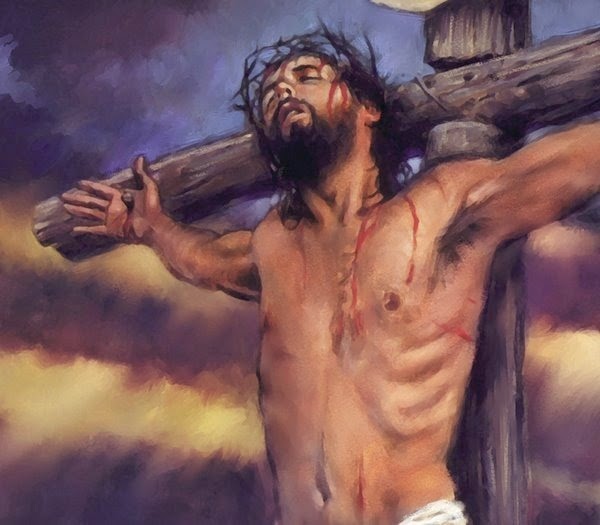
Let’s fast forward to Good Friday.  On the cross Jesus again showed us great humility.  He poured Himself out for us once again.  He extended Himself for our sake.  His self-giving was total and complete.  He exemplified true love—a love that is never selfish.  You don’t see Jesus hanging from the cross saying:  What am I getting out of this?  What’s in it for ME?  No, in humility he faced a shameful death on the cross out of love.


Today, Holy Thursday, our altar becomes the Upper Room.  We hear Jesus speak those timeless words over the bread and wine:  This is my Body.  This is my Blood.  Once again, He pours Himself out for us.  He gives Himself totally and completely to us.  He extends Himself for us.

All three actions, the foot-washing, the gift of the Holy Eucharist and Jesus’ death on the cross are intimately tied together and have their source in one act of the will:  Jesus’ Yes to His Father.  “My Father, if it is possible, let this cup pass from me; yet, not as I will, but as you will.”  (Mt. 26:39)  Jesus perfectly fulfilled the will of His Father.

Finally, today’s Mass commemorates the institution of the ministerial or ordained priesthood by Jesus.  Referring to the Holy Eucharist, Jesus told His disciples to “do this in memory of me” (Lk. 22:19) and He gave them His divine authority to do so.  Priests act in the name of and with the authority of Jesus Himself.  Priests administer the sacraments in persona Christi.  This is not to say that priests are without faults or sinless.  Unfortunately, this is not the case.  Yet, if we realize that Jesus, who is God, deliberately picked a disciple who betrayed Him, a disciple who denied Him three times and others who ran away from the shame of the cross, then we may begin to understand how God paradoxically and mysteriously “chose the foolish of the world to shame the wise, and God chose the weak of the world to shame the strong.” (1 Cor. 1:27)  It is because Jesus accomplishes his saving actions through us and sometimes despite us, not because of us.  It is Jesus who makes things happen, using His chosen priests with all of their flaws.  It’s all about Jesus and not really about us.  Please pray for your priests.

Now, as I prepare to wash the feet of twelve parishioners, please remember the absolute humility and self-giving that Jesus shows us by His actions.

Sunday, December 29, 2013

Christmas: When God Became Vulnerable


(The following homily was originally preached for Christmas Mass 2013 at St. Joseph Parish, Somers Point, NJ, and then further developed for a presentation at Infant Jesus Parish, Woodbury Heights, NJ)

Can you think of some of the times in your life when you have been vulnerable?

When I googled the word vulnerable, like many young people probably still do, I found the following definition: susceptible to physical or emotional attack or harm.

When are we most vulnerable?

Could it be times when we share an important secret with a friend and trust that he or she will not tell anyone else?  How about during the Sacrament of Penance and Reconciliation—in Confession—when we reveal our deepest, darkest sinfulness to a priest and we hope that we will never see him again and that he would never, ever break the seal of confession? Aren’t we emotionally vulnerable at times like these?

We might allow ourselves to be vulnerable, when we undergo some medical procedure and authorize a surgeon or physician to perform surgery or some medical procedure on us. I have been under anesthesia at least a half-dozen times in my life, and I was certainly quite vulnerable to whatever might happen to me while I was unconscious.

I’m pretty sure most of us have been up in a plane at least once. When we are up there twenty or thirty thousand feet above the ground, aren’t we just a bit vulnerable to so many things beyond our control: the expertise and physical well-being of the pilot, the maintenance and condition of the plane, unforeseen weather conditions, even random flying objects—like a flock of Canadian geese. Just ask retired US Airways Captain Chesley "Sulley" Sullenberger about that one!

I can remember quite some time ago, in my younger and stupider days, when I decided to take a sightseeing flight in a small four seat plane over the Grand Canyon. I got into the front of the plane next to the pilot. Behind us was a young couple on their honeymoon. The young pilot started giving me some emergency instructions concerning the operation and evacuation of the plane. He then looked up and smirked at me: “You’re the only co-pilot that I have!” Gulp! Is that not a good example of being vulnerable?

Aren’t a husband and a wife vulnerable to each other at so many different times and on various levels during their married lives? I suspect that this vulnerability is a large part of the pain of a divorce, at those times when it unfortunately occurs. 

Certainly, the most memorable experience of being vulnerable for me was when I recall almost drowning in the Atlantic Ocean, having been caught in a forceful rip-tide. I had never felt so vulnerable in all my life! In fact, I really thought that I was going to die, having been pulled under the ferocious waves multiple times.


Well, what happened at Christmas, with the Incarnation of Our Lord, was that God became vulnerable. We see Him as a helpless infant in a manger.  He couldn’t feed Himself, clean Himself, clothe Himself, or protect Himself, exactly like any newborn infant. He was completely vulnerable. There, when viewing Him in the manger, he doesn’t look like some powerful mythological god that is about to throw a lightning bolt at us if we get out of line. He doesn’t look like someone who might even call up legions of angels to protect Him or defend Him at His command. (See Jn. 18:36) In fact, He doesn’t look so tough at all there in those swaddling clothes.

Was his precious care given to an experienced mother or nanny? No, He was entrusted to “a virgin betrothed to a man named Joseph.” (Lk. 1:27) Mary was, in all likelihood, still a teenager with no expertise in child-bearing—“How can this be, since I have no relations with a man?” (Lk. 1:34)—or in child-rearing. Yet, God entrusted the care of His only Son to her.

And what about Joseph, her husband? God chose him to protect His only Son from the designs of the evil King Herod. Joseph had to transport both Mother and Child away from harm to a foreign land. Wasn’t the Child vulnerable to the evil plots of Herod as so many of the Holy Innocents were? Wasn’t He vulnerable to the unknown circumstances and conditions of a foreign land? Didn’t Joseph have to watch and protect Him, care for Him and support Him, as He was growing up, as any responsible father should do?

Yes, God became vulnerable when “the Word became flesh and dwelt among us.” (Jn. 1: 14) God entrusted His only Son into our hands.  He permitted His Son to suffer and die.  He allowed Him to feel pain. He allowed Him to be rejected.  He allowed Him to die on a cross. He allowed Him to be vulnerable.

And so, when we think that we do God some type of favor by coming to worship Him whenever we feel like it, or we think that that God doesn’t really care about us, or that God doesn’t hear our prayers, or that God might not even really exist, take a moment and look at the vulnerable infant in the manger. See how God has completely and totally opened Himself up to us. A helpless, little baby is revealed to us, given to us.

Who came to see Him in His vulnerability? “Now there were shepherds in that region living in the fields and keeping the night watch over their flock.” (Lk. 2:8) Poor shepherds were able to view a helpless, vulnerable God in a manger—in an animal feeder—located in a stable (or cave) within the city called Bethlehem—the House of Bread. Later, “magi from the east” (Mt. 2:1) arrived “offering gifts of gold, frankincense and myrrh.” (Mt. 2: 11) Strange, isn’t it, how these foreign dignitaries seemed to see beyond the child’s vulnerability (myrrh--an embalming oil as a symbol for death) also to perceive both His royalty (gold) and His divinity (frankincense) through their gifts.  Through the magi, the entire world views a vulnerable God.

I think that Jesus continues His vulnerability with us even today by giving us Himself in the Holy Eucharist. How ordinary bread and wine can be transformed into His Body and Blood and then given to us to eat! “Take and eat; this is my Body” (Mt. 26:26) What do we do with this precious gift? Do we still somehow treat it like ordinary bread? Do we receive it worthily? Do we just go through the motions? Do we realize that Jesus is once again giving Himself to us, completely and totally? Isn’t He in some way mysteriously making Himself vulnerable to us again ? Will we or do we doubt, take for granted or even reject His unconditional love for us given in the Holy Eucharist?

Think of how vulnerable Jesus was in His public life, in His preaching and teaching, in His passion and death. He was accepted by some, rejected by others. Ultimately, he was brutally tortured and put to death on a cross because God allowed Himself to be vulnerable—to be rejected, to feel pain, to suffer. And His Mother Mary shared in this vulnerability with Him from the very beginning: “I am the handmaid of the Lord.   May it be done to me according to your word.” (Lk. 1: 38)


Remember what was said by Simeon at the presentation of Jesus in the Temple by Joseph and Mary:

Simeon blessed them and said to Mary his mother, “Behold, this child is destined for the fall and rise of many in Israel, and to be a sign that will be contradicted (and you yourself a sword will pierce) so that the thoughts of many hearts may be revealed.”  (Lk. 2: 34-35)
She was so completely vulnerable, especially witnessing Her Son’s death at the foot of the cross.

Pope Francis in his homily at Christmas midnight Mass this year (2013) spoke the following words:

The shepherds were the first to see this “tent”, to receive the news of Jesus’ birth. They were the first because they were among the last, the outcast. And they were the first because they were awake, keeping watch in the night, guarding their flocks. The pilgrim is bound by duty to keep watch and the shepherds did just that. Together with them, let us pause before the Child, let us pause in silence. Together with them, let us thank the Lord for having given Jesus to us, and with them let us raise from the depths of our hearts the praises of his fidelity: We bless you, Lord God most high, who lowered yourself for our sake. You are immense, and you made yourself small; you are rich and you made yourself poor; you are all-powerful and you made yourself vulnerable. (emphasis added)

Don’t you just love it when the Pope agrees with you!

Merry Christmas!

Monday, June 3, 2013

Homily for the Silver Jubilee of Fr. Joseph T. Szolack

June 2, 2013
Infant Jesus Parish, Woodbury Heights, NJ


I thank Fr. Szolack for giving me this opportunity to preach at his Jubilee Mass.  I consider it an honor.  The verdict is still out, however, on what he will ultimately think of his choice of homilist by the time I reach my conclusion.

We go back quite a long way—to 1979 to be precise.  We met while attending college as students at St. Charles Borromeo Seminary.  Put together by some unforeseen Divine plan, we were two young men, among various others, who entered the seminary right out of high school.  It was something rare then; perhaps even more rare today.  We seemed to hear a similar “call” from God to be His priest.  He was a freshman, and I, a sophomore; 1st and 2nd college as it was referred to by those who attended Overbrook.  I was glad to have another seminarian from the Camden diocese studying at the same seminary as me, since so many of our men were being sent to another seminary at a different location for their formation.

While I only spent my college years there, I think Fr. Szolack really, really liked it at St. Charles.  Not only did he tirelessly devote hours upon hours of sleepless nights not studying there during his college years, but he remained there for four additional years of theological study and formation.  After ordination, he returned to the seminary initially for three years, then again, by the most mysterious Hand of God, as Dean of Men for the Theology Division for another six yearsSeventeen years in an institution—it explains an awful lot, doesn’t it?

-------------------------------------------------------------------------

As we pray and offer this Mass during the Hour of Divine Mercy, I remember being on retreat several years ago at Trinity Retreat in Larchmont, NY.  The retreat master, Fr. Gene Fulton, told the priests a story of a newly ordained priest.  He was giving his first priestly blessing to the congregation after his ordination.  In the crowd was a rather famous Russian baroness, Catherine de Hueck Doherty, the foundress of Madonna House  (Combermere, Ontario) who is now being considered for sainthood.  After receiving the priest’s blessing, the baroness took the priest’s consecrated hands and began to kiss them.  The priest then pulled his hands back.  Looking directly him, she spoke something quite forcefully in her thick Russian accent to this newly ordained:  “It’s not for you!”  It’s not for you.

I’d like to remind all of us that while we are celebrating and honoring Fr. Szolack for his 25 years of priestly service, all of what he has done and, with God’s grace, will continue to do as a priest is truly about Jesus Christ.  Fr. Szolack is a priest of Jesus Christ.  The priest is an alter Christus—another Christ.

Pope Benedict XVI tells us the following in a general audience in St. Peter’s Square:


As an alter Christus, the priest is profoundly united to the Word of the Father who, in becoming incarnate took the form of a servant, he became a servant (Phil 2: 5-11). The priest is a servant of Christ, in the sense that his existence, configured to Christ ontologically, acquires an essentially relational character: he is in Christ, for Christ and with Christ, at the service of humankind. Because he belongs to Christ, the priest is radically at the service of all people: he is the minister of their salvation, their happiness and their authentic liberation, developing, in this gradual assumption of Christ's will, in prayer, in "being heart to heart" with him. Therefore this is the indispensable condition for every proclamation, which entails participation in the sacramental offering of the Eucharist and docile obedience to the Church. (June 24, 2009)


Additionally, the Catechism of the Catholic Church reminds us that a priest acts in persona Christi (capitis) when administering the sacraments.  Jesus continues His saving work among His people, among His Church, through the working of His priests.  When the priest baptizes, it is Jesus who baptizes.  When the priest anoints, it is Jesus who anoints.  When the priest forgives sin, it is Jesus who forgives sin.  When the priest says “This is my Body,” it is Jesus who once again gives Himself to us in the Holy Eucharist.  And Fr. Szolack, in fact every validly ordained priest, embodies Christ to the world.

Do we deserve this great honor, this most sacred privilege?  Certainly not.  We are sinful, frail human beings “called” nevertheless by God to do the most spiritual, indeed supernatural actions.  Pray for your priests.  Pray for Fr. Szolack.  Without your prayers and the Grace of God, I don’t know how any of us could stand at the altar each day.

While we are aware that this day honors Fr. Szolack and his 25 years as a priest, let us not forget the solemnity that we celebrate—Corpus Christi (The Most Holy Body and Blood of Christ).  The mysterious high priest and king, Melchizedek, in our first reading and psalm offered gifts of bread and wine in thanksgiving.  This foreshadowed and anticipated the sacrifice of Christ at the Last Supper.  Jesus feeds the five thousand with five loaves and two fish in the Gospel.  Again we see an anticipation of and a prefiguring of the Holy Eucharist in Christ’s action.  St. Paul echoes the words of Christ in his first letter to the Corinthians:  “This is my body that is for you. . . this cup is the new covenant in my blood.”  We hear the words that the priest continues to speak at each Mass.

The priest is so completely tied into the offering of the sacrifice, to the Mass itself.  Pope John Paul II reminds us:


The Second Vatican Council recalled: "Priests act especially in the person of Christ as ministers of holy things, especially in the Sacrifice of the Mass" (PO 13) and that without a priest there can be no Eucharistic sacrifice. However, it emphasized that those who celebrate this sacrifice must fulfill their role in intimate spiritual union with Christ, with great humility, as his ministers in the service of the community . . . In offering the Eucharistic sacrifice, presbyters must offer themselves personally with Christ, accepting all the renunciation and sacrifice required by their priestly life--again and always, with Christ and like Christ, sacerdos et hostia (priest and victim). (June 9, 1993)


Fr. Szolack has faithfully offered Mass essentially every day during the duration of his priesthood.  Whether with his parish congregation, privately, on vacation, on a cruise ship, in a hotel room, on an island, or in a private home, he has prayed and offered the sacrifice of Jesus for the People of God.  Together with his Divine Office (Breviary or Liturgy of the Hours) he has been faithful in praying for himself and for those whom he is called to serve.
         
I don’t know exactly who is aware of it but one of the things that Fr. Szolack did after he became pastor was to establish a small chapel in the rectory so that he could reserve the Blessed Sacrament there for prayer.  I guess that he was in tune with something else Pope John Paul II reminded priests:


To priests the Council also recommends, in addition to the daily celebration of the Mass, personal devotion to the Holy Eucharist, and especially that "daily colloquy with Christ, a visit to and veneration of the Most Holy Eucharist" (PO 18). Faith in and love for the Eucharist cannot allow Christ's presence in the tabernacle to remain alone (cf. CCC 1418). Already in the Old Testament we read that God dwelt in a "tent" (or "tabernacle"), which was called the "meeting tent" (Ex 33:7). The meeting was desired by God. It can be said that in the tabernacle of the Eucharist too Christ is present in view of a dialogue with his new people and with individual believers. The presbyter is the first one called to enter this meeting tent, to visit Christ in the tabernacle for a "daily talk." (June 9, 1993)


On Friday, Fr. Szolack called me and asked me to wear the vestment that I currently am wearing.  He informed me that he had been given a similar one by his mother.  The vestment is in honor of Our Lady of Czestochowa, reflecting our common Polish heritage.  We had visited the shrine in Poland together where the sacred icon is revered by multitudes.  I know that he and I have entrusted, consecrated our priesthood to the care of Our Lady.  She who is the Mother of the Great High Priest, Jesus Christ, continues to intercede for us, to watch over us and to lead us to Jesus, her Divine Son.  Fr. Szolack and I have a tremendous love for Our Lady, her rosary, her scapular as did the Pope that we both greatly admire, John Paul II.

With a new Holy Father Pope Francis now leading us, I conclude with a few of his words in reference to Mary, Our Mother:


Jesus from the Cross says to Mary, indicating John: “Woman, behold your son!” and to John: “Here is your mother!” (cf. Jn. 19:26-27). In that disciple, we are all represented: the Lord entrusts us to the loving and tender hands of the Mother, that we might feel her support in facing and overcoming the difficulties of our human and Christian journey; to never be afraid of the struggle, to face it with the help of the mother. . . The mother teaches us how to be fruitful, to be open to life and to always bear good fruit, joyful fruit, hopeful fruit, and never to lose hope, to give life to others, physical and spiritual life. (May 4, 2013)

May Our Lady, Our Mother, continue to assist you and all of us priests in our ministry.  May she be revered as a loving Mother for all the faithful.  May she lead us all to Jesus Christ, the Great High Priest.


I mentioned earlier that priesthood itself is essentially not about you, Fr. Szolack.  However, I think that I speak for all here and for all the people who have seen you trying to live out your priestly vocation by saying “thank you” for responding to the call of Jesus and becoming His priest.  Thank you for your many years of dedicated service to the People of God.  May God give you the health and the strength to serve many, many more years as His priest at His sacred altar.

Ad multos annos.